
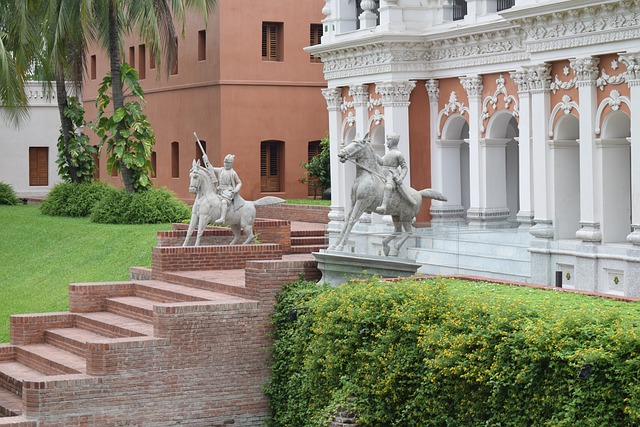
Narayanganj
Narayanganj is a lively city in central Bangladesh. It is part of the Narayanganj District and is very close to Dhaka, the capital of Bangladesh. About 5 million people live in Narayanganj. The city is by the Shitalakshya River and is known as "The River Port of Narayanganj." This port is one of the oldest in Bangladesh and has been important for trade and industry, especially for jute and textiles. Because of its many jute mills, Narayanganj is often called the "Dundee of Bangladesh," similar to Dundee in Scotland, which was famous for jute.
A Look Back at History
Narayanganj got its name from Bicon Lal Pandey, a Hindu religious leader also known as Benur Thakur or Lakhsmi Narayan Thakur. In 1766, after the Battle of Plassey, Pandey leased the area from the British East India Company. He gave the markets and the land by the river for the worship of the god Narayan. Over time, Narayanganj became a busy center for business and industry.
The town became a municipality in 1876. Important events include the opening of a post office in 1866, the start of the Dhaka-Narayanganj telegraph service in 1877, and the first telephone service by the Bank of Bengal in 1882. The Narayanganj Victoria Hospital, the area's first hospital, was built in 1885 with help from the municipality and Harakanta Banerjee.
Geography and Climate
Narayanganj is part of the Dhaka Division and is surrounded by Gazipur and Narsingdi to the north, Brahmanbaria and Comilla to the east, Munshiganj to the south, and Dhaka to the west. The city is about 20 kilometers southeast of Dhaka and is on the flat Ganges Delta. The Shitalakshya River divides Narayanganj into two parts: the Narayanganj Municipal Area and the Kadam Rasul Municipal Area. These areas are connected by canals that fill with rainwater during the monsoon season. The city gets about 2,550 mm of rain each year, mostly between May and October.
Economic Importance
Narayanganj is very important to Bangladesh’s economy. It makes 55% of the country's knitwear and has 33% of the textile mills. The Adamjee Export Processing Zone (AEPZ), set up in 2006, has attracted many local and international businesses, creating many jobs and bringing in a lot of export revenue. The river port near Dhaka is vital for trade and handles a large part of the country's exports and imports.
Even though Narayanganj is economically strong, it faces problems like fast urban growth, industrial pollution, and poor infrastructure. The city's industries, especially the jute mills, have had ups and downs. The Adamjee Jute Mill, once the biggest in Asia, closed in 2002 because of losses. However, the textile and garment sectors are still doing well and employ over 130,000 people as of 2011.
Environmental and Urban Challenges
Narayanganj’s quick industrial growth has caused environmental problems. Many factories do not have proper waste treatment plants, leading to water, air, and noise pollution. The Narayanganj City Corporation (NCC), set up recently, is struggling with bad infrastructure, poor waste management, and unplanned urban growth, making the city less livable.
Socio-Economic Development
Narayanganj’s economy is diverse. The city’s good location and business-friendly environment attract many local and foreign investments. Various industries, including cotton and small-to-medium businesses, provide many job opportunities, helping the local economy. Agriculture is also important for the rural areas of Narayanganj. International trade, shipyards, and brickfields also boost the economy.
Narayanganj has a rich history and culture. The area was once ruled by the Palas and Senas dynasties, became part of the Muslim Bengal Sultanate in the 14th century, and was later under the Mughals. Sonargaon, the capital during Isa Khan's rule, is in this district. The region saw significant development in the 19th century with the arrival of European jute traders.
Modern Narayanganj
Today, Narayanganj is a busy city known for its history and industry. The city continues to grow, with a population density of 5,712 people per square kilometer as of the 2022 Census. It has a higher literacy rate (79.24%) than the national average and a large urban population. However, the fast pace of industrialization and urban growth requires careful planning for a better future.
Tourist Attractions
Narayanganj is not just about industry; it also has several attractions for tourists. Here are some key places to visit:
-
Sonargaon: This ancient town was once the capital of Bengal and is now a museum and heritage site. Visitors can explore historic buildings, traditional crafts, and a beautiful rural landscape.
-
Panam City: Near Sonargaon, Panam City is an abandoned city that dates back to the Mughal period. It has well-preserved buildings and streets, giving a glimpse into the past.
-
Tomb of Ghiyasuddin Azam Shah: This historic tomb, dating back to 1410, is an important monument and a place of interest for history enthusiasts.
-
Kadam Rasul: This religious site houses the footprints of the Prophet Muhammad (PBUH) and is a significant place for pilgrims and visitors alike.
-
Bibi Mariam's Tomb: Another historical site, this tomb is dedicated to Bibi Mariam, a significant figure in the region's history.
-
Shitalakshya River: The river itself is a major attraction. Visitors can enjoy boat rides and see the bustling activities along the riverbanks.
Conclusion
Narayanganj is a key city in Bangladesh’s industrial and economic development. Its history, good location, and industrial power make it very important. To keep growing, the city needs to balance industrial growth with environmental care and good planning. This will ensure Narayanganj continues to be a great place to live and work, contributing to Bangladesh's success. With its rich history and cultural sites, Narayanganj also offers a lot for tourists to explore and enjoy.
