
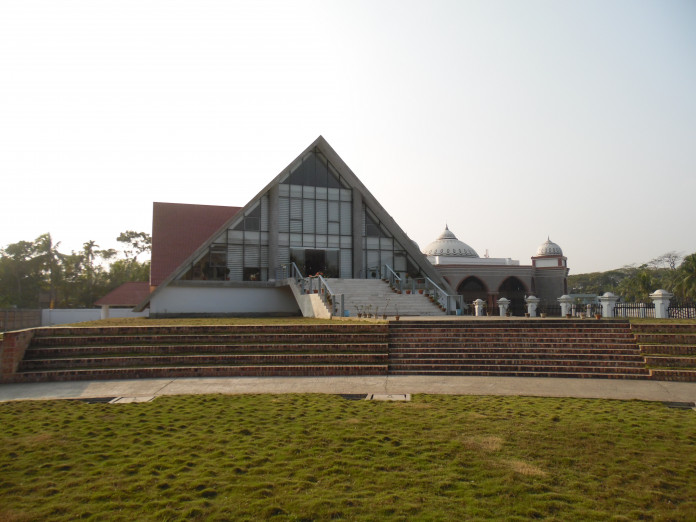
Bhola
Bhola, the largest island district of Bangladesh, is often referred to as the “Queen Island of Bangladesh.” The district is famous nationwide for the sweets of Ghuingar Hat and the yogurt of the Ghosh community. With its numerous rivers, chars (riverine islands), and scenic beauty, Bhola has become a favorite destination for tourists. Among its notable attractions are Monpura Island, Char Kukri Mukri, Dhal Char, and the towering Jacob Tower, which offers panoramic views of the vast Meghna estuary.
The Birth of an Island
Bhola is essentially a land of fertile alluvium. Over centuries, the island formed from silt carried down by three mighty rivers—the Jamuna, the Padma, and the Brahmaputra. As these rivers entered the Bay of Bengal, they slowed down when meeting the Meghna to the east and the Tetulia to the west, causing sediment and debris to accumulate. Over time, this process gave birth to the island now known as Bhola.
Historical records suggest that around 1235 AD, land first began to emerge here, and by 1300 AD, people had started farming on these newly formed chars. By the 1500s, the island attracted the attention of Magh and Portuguese pirates, who used it as a base to raid different regions of Bengal. In fact, Bhola’s original name was Shahbazpur, and during that period, fear of raids spread widely among the people. The lullaby-like rhyme that says, “Khoka ghumalo, para juralo, Borgi elo deshe…” (The child sleeps, the village rests, but the raiders arrive) is believed to have originated from such events.
The Portuguese Footprint
According to government records, in 1517, a Portuguese pirate named John de Silveira seized control of Shahbazpur. The Portuguese established bases on Monpura Island, which became their stronghold. Interestingly, even today, some descendants of their introduced species—large hairy dogs—can still be found roaming parts of Monpura.
Until 1822, Shahbazpur (modern-day Bhola) was a part of Bakerganj (now Barisal). But due to the expansion of two rivers—the Ilisha (a branch of the Meghna) and the Kalabodor (a branch of the Tetulia)—boat travel between Shahbazpur and Bakerganj became nearly impossible. As a result, the British administration decided to attach Shahbazpur and nearby Hatiya to Noakhali, a decision implemented on July 3, 1822. For nearly half a century, Bhola remained under Noakhali’s administration until 1869, when it was reattached to Barisal.
A Melting Pot of People
Today, Bhola spans nearly 90 miles in length and 25 miles in width. Over time, it has become home to settlers from five districts: Barisal, Patuakhali, Noakhali, Faridpur, and Bikrampur.
The earliest settlers came from Noakhali—particularly from Hatiya, Ramgati, Alexander, and Mozu Chowdhury Hat—seeking fertile land. At the same time, erosion-affected families from Barisal’s Mehendiganj, Hijla, and Muladi, as well as from Patuakhali’s Bauphal, Dashmina, and Galachipa, migrated here. Later, people from Faridpur and Bikrampur also moved in, establishing trade and business centers. Over centuries, this mix of people gave Bhola its unique identity as a true cultural melting pot.
A Land of Diverse Dialects
The diversity of Bhola’s population is reflected in its language. While standard Bangla is widely spoken, three regional dialects dominate—Pubal, Baklai, and Barishailya.
-
Pubal Dialect: Spoken mostly by settlers from eastern Noakhali, with words like “Achukka” (suddenly), “Huni ja” (listen), “Ami a” (come here), “Jaitam no” (I won’t go).
-
Baklai Dialect: Common among migrants from Barisal, Faridpur, and Bikrampur. It features phrases like “Hukne ay” (come forward), “Kotha koich na” (don’t speak), “Jut koirya thak” (stay quiet), “Kohhoindya jabi” (which way will you go).
-
Barishailya Dialect: An older Barisal speech form, still heard in parts of Bhola, with expressions like “Huinga ja” (listen), “Tor keichilamna” (didn’t I tell you), “Mui jait parum na” (I can’t go).
Among these, the Baklai dialect is the most widely spoken across the district, followed by Pubal and then Barishailya, which survives in smaller communities.
Culture and Hospitality
Despite their linguistic differences, Bhola’s people are known for being peaceful, warm, and hospitable. The region has preserved many old traditions—such as welcoming sons-in-law with a feast of duck meat, buffalo yogurt, and fresh river hilsa fish during winter. The people also take pride in their lush coconut and betel nut groves, as well as their fertile fields that yield abundant crops.
Natural Resources and Progress
Bhola is not only blessed with fertile lands and rivers full of hilsa but also with hidden natural wealth. Beneath its soil lies a vast reserve of natural gas, which today powers a 250-megawatt electricity plant. This energy has brought new possibilities for industrialization and development in the district.
Conclusion
Bhola is more than just an island—it is a land of history, migration, cultural blending, and natural abundance. From the haunting tales of pirates and settlers to the present-day harmony of its people, Bhola continues to embody the spirit of resilience and hospitality. Known as the “Queen Island,” it remains one of the most unique and enchanting districts of Bangladesh, where rivers meet land, and diverse traditions live together side by side.
